

Tooth Fillings in Placeholder Nagar
- 0000+Placeholder: fillings placed
- 00 minPlaceholder: average waiting time
- 0.0Placeholder: patient rating
- 30–45 minutes per tooth
- single visit for a direct filling
- Mon – Sat: 10:30 AM – 9:00 PM
What Is a Tooth Filling?
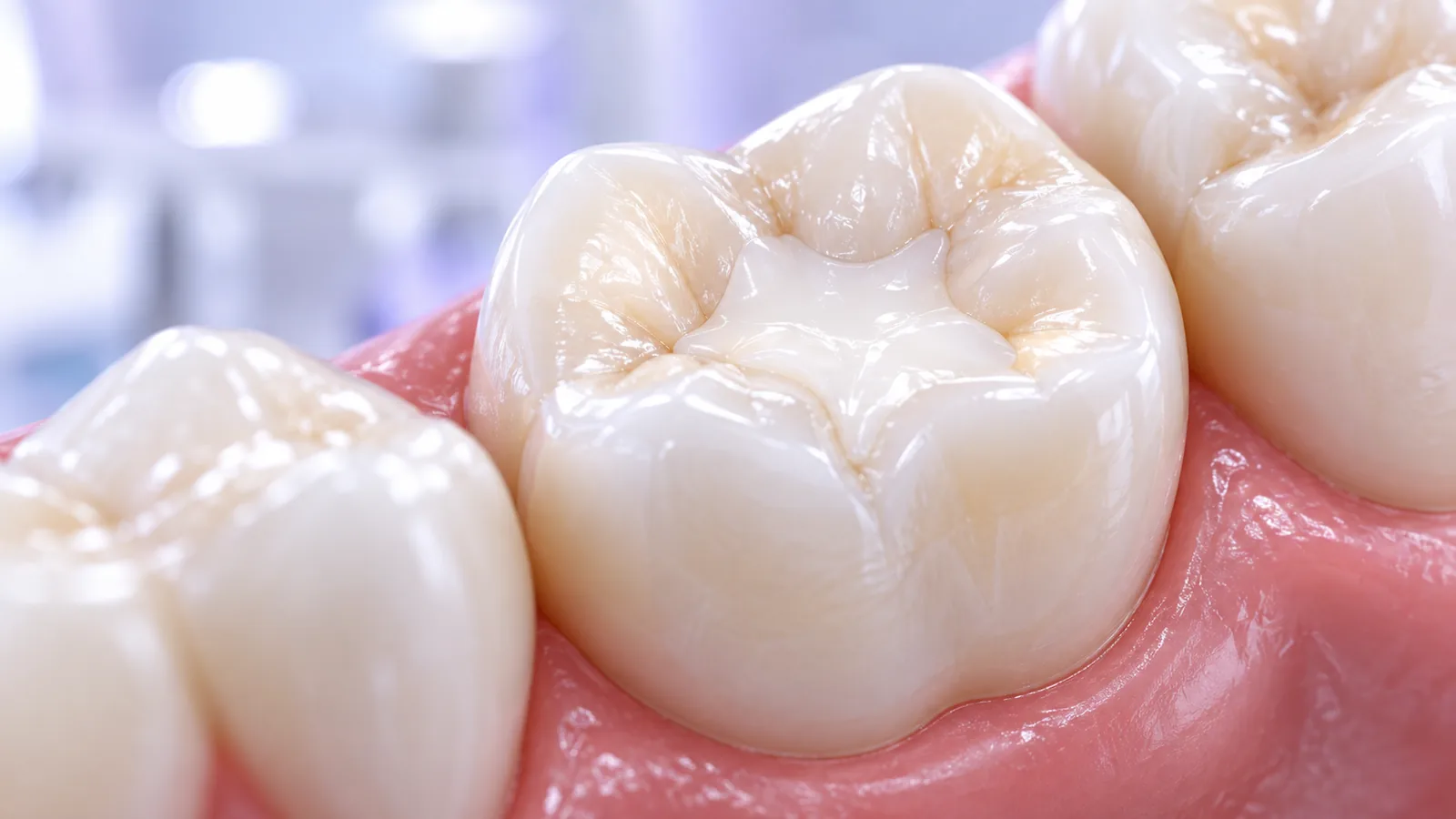
A tooth filling rebuilds the part of a tooth that has been lost — to decay, to a chip, or to an older filling that has given way. The damaged material is taken out, the space is cleaned, and a restorative material is placed into it and shaped back to the tooth’s original contour. Done properly, the tooth goes back to biting, chewing and feeling the way it did before.
Most of the skill is in the parts nobody sees. A filling has to seal at its margin, or bacteria simply carry on underneath it. It has to rebuild the tight contact against the tooth next door, or food packs into the gap at every meal. And it has to meet the opposing tooth evenly, because a filling a fraction too high aches every time you close. Those three things, far more than the material, decide how long a filling lasts.
Which material goes in depends on the tooth. A visible front tooth wants composite, bonded and shaded to match. A wide cavity on a molar taking heavy chewing force is often better served by a ceramic onlay made to fit it. A child’s tooth, or a cavity down at the root surface, usually calls for glass ionomer and the fluoride it releases. The right answer is the one that suits where the tooth sits and what it has to do.
Two Ways a Filling Is Made
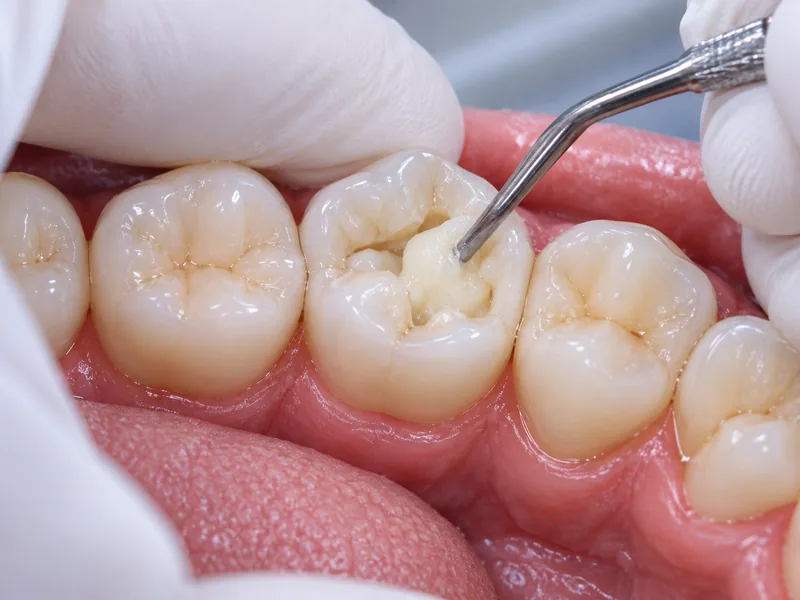
Direct — Built in the Tooth
The usual route. The material goes into the cavity as a paste, is shaped against the neighbouring teeth and hardened in place with a light. One appointment from start to finish, and the tooth leaves ready to chew on.
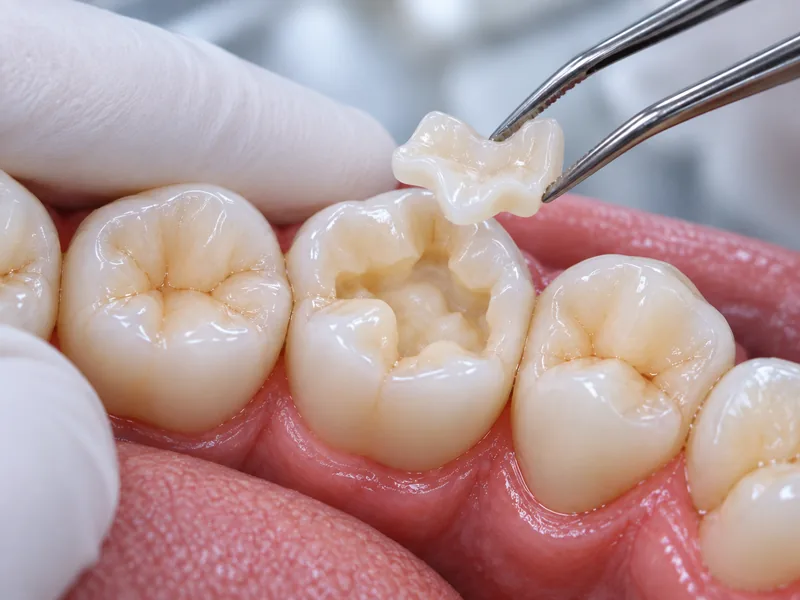
Indirect — Made Outside and Fitted
For a cavity too wide for the tooth to support a direct filling. A scan or impression is taken, an inlay or onlay is made to fit the space exactly, and it is bonded in at a second visit. Stronger, and it holds its shape under heavy chewing.
When Is a Filling the Right Repair?
A filling rebuilds what is missing, as long as enough sound tooth is left around it to hold the repair. These are the situations it handles — anything past them needs an onlay, a crown, or a root canal first.
- A small or medium cavityDecay through the enamel but well clear of the nerve, with solid walls left around it.
- A chipped or broken cornerA piece broken off an edge, where the rest of the tooth is still sound.
- A worn notch at the gum lineA groove worn into the neck of the tooth, usually sensitive to anything cold.
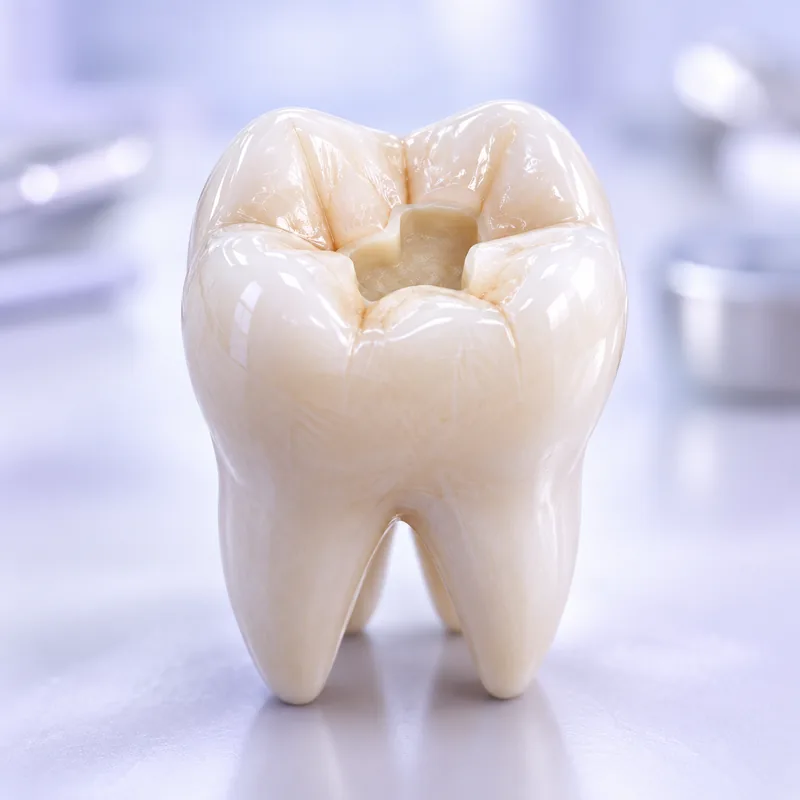
- An old filling that has failedA dark line at the margin, a rough edge, or a filling that has cracked or come out.
- Food packing between two teethA contact that has broken down, so food wedges in the same place at every meal.
- A surface that has turned sensitiveExposed dentine reacting to cold, where sealing the surface is the simplest answer.
Options
Types of Filling Material
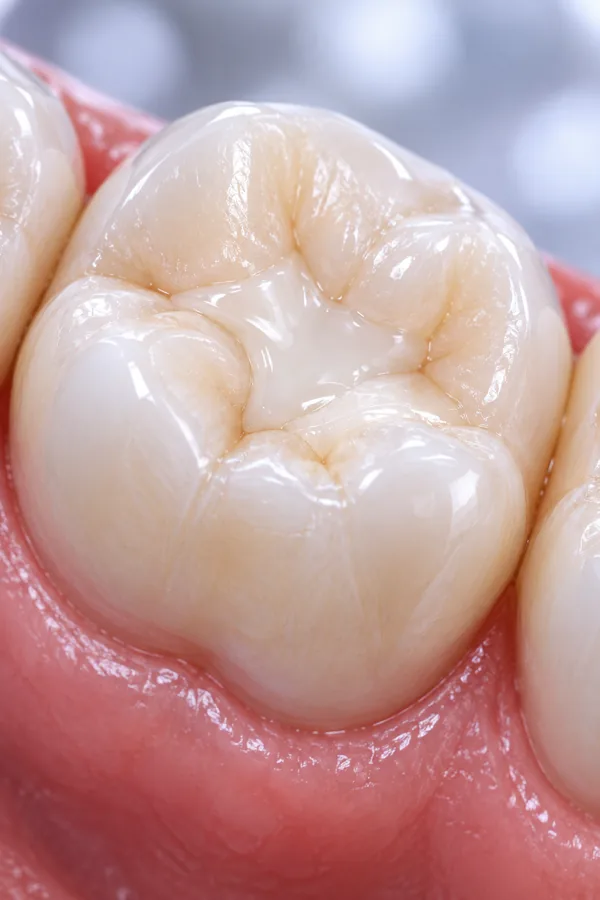
There is no single best material. What suits a tooth depends on where it sits, how much chewing force it takes, how large the cavity is, and how visible it is when you smile.
 1
Composite — tooth-coloured
Resin shaded to match your tooth and bonded to it, so less healthy tooth has to be removed. The default for front teeth and for most back teeth.
 2
Glass ionomer
Releases fluoride into the tooth around it, which makes it useful for children, for root surfaces, and for places that are hard to keep dry.
 3
Ceramic inlay or onlay
Porcelain made to fit the cavity exactly and then bonded in. Stain-resistant and very strong — for wide cavities in back teeth.
 4
Silver amalgam
The traditional metal filling. Hard-wearing and tolerant of moisture, but grey, and it needs more tooth removed to lock it in place.
How Is a Filling Placed?
Numbing and clearing the cavity
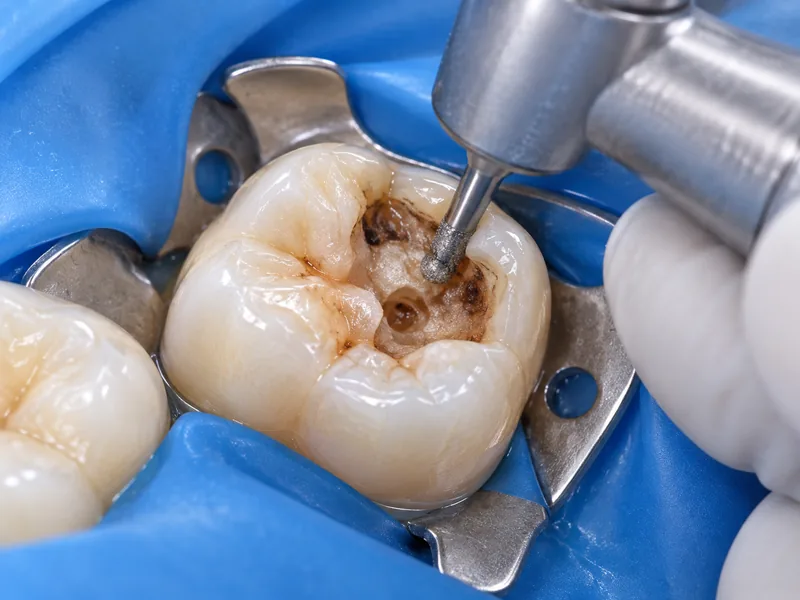
The tooth and the gum around it are numbed, and the area is isolated to keep it dry, because bonding fails on a wet surface. The decayed tooth is then removed completely, down to sound structure. How much has to come out is what decides whether a filling will hold at all, or whether the tooth needs an onlay or a crown instead.
Building the tooth back up
Composite goes in as thin layers, each one hardened with a light before the next, which stops it shrinking away from the walls as it sets. The shape is rebuilt as it was — the ridges on the biting surface, and, most importantly, the tight contact against the neighbouring tooth that keeps food from packing in.

Polishing and adjusting the bite
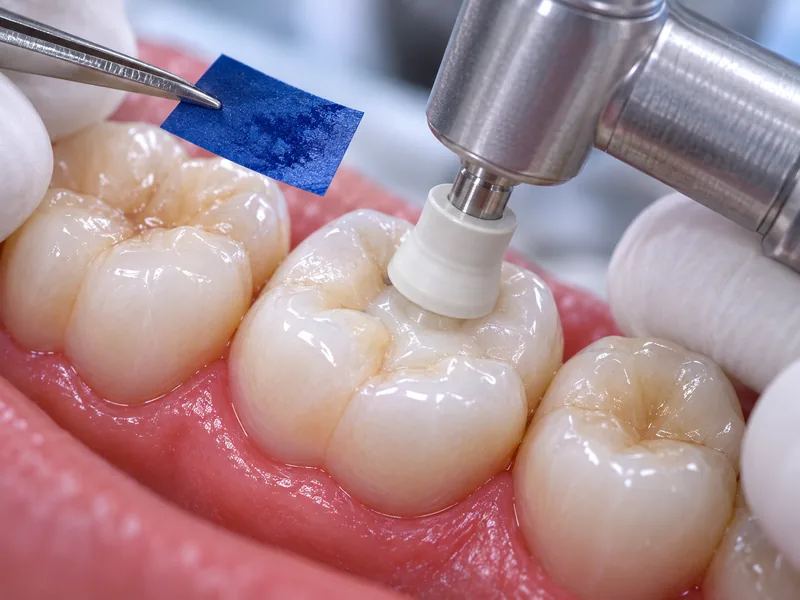
The filling is trimmed and polished until it feels like tooth to your tongue, because a rough surface collects plaque in exactly the place you least want it. You then bite on marking paper so the dentist can see where it meets first, and it is adjusted until the bite feels even. This is the step that decides whether the filling feels like nothing at all.
Recovery
Looking After Your Filling
A filling is a repair, not a spare part. How long it lasts depends more on what happens after you leave than on which material went in.
- 1
Eating afterwards
Composite is fully hardened before you leave, so eat as soon as the numbness has gone. Amalgam takes about 24 hours to reach full strength — keep hard food off that side until then.
- 2
Sensitivity settles
Cold and pressure can feel sharper for a few days, and for two to three weeks where the cavity was deep. It should be fading, not building.
- 3
What shortens a filling's life
Grinding at night, chewing ice, and plaque sitting at the margin where filling meets tooth. Cleaning between the teeth daily is what stops decay starting underneath.
- 4
When it needs replacing
A dark line at the edge, a rough margin, food beginning to pack in, or sensitivity coming back. Fillings are checked at every appointment and replaced before they leak.
Which to choose
Tooth-Coloured Filling vs Silver Amalgam
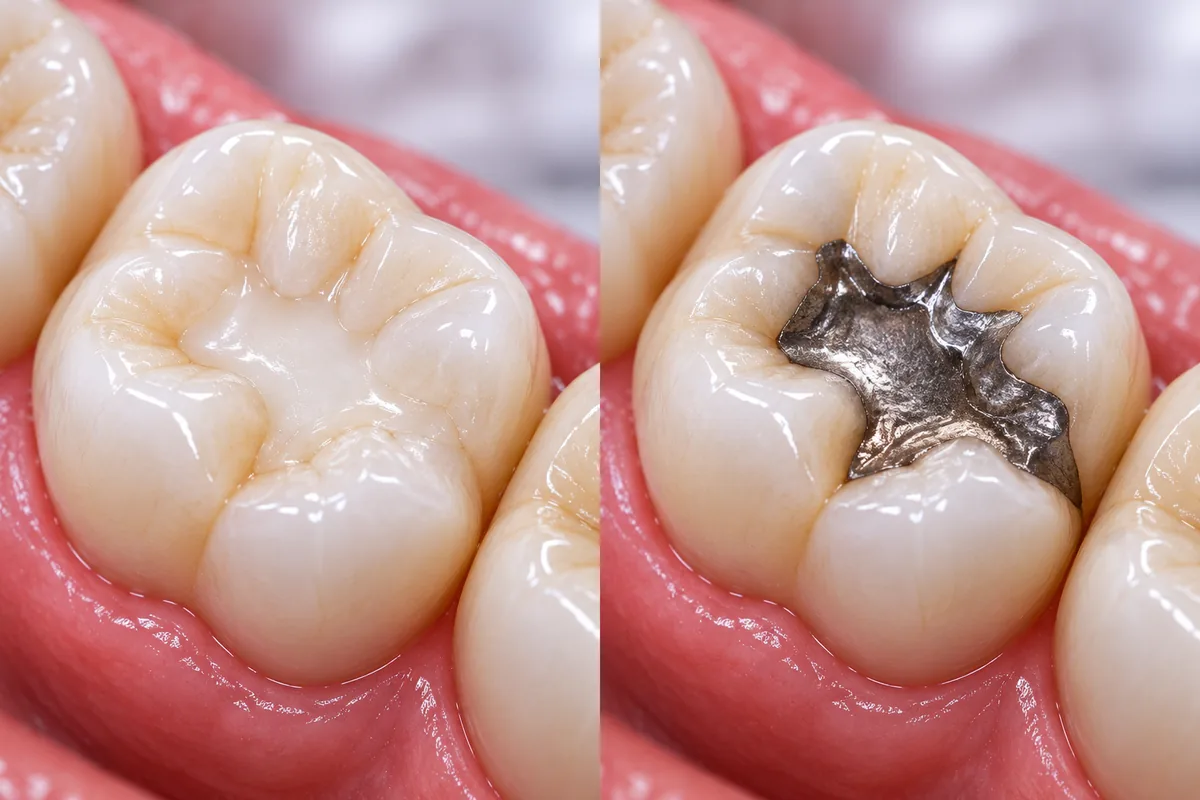
Amalgam has been used for over a century because it is tough, quick to place and forgiving of a damp working field. Composite matches the tooth, bonds to it, and is what nearly every patient now asks for.
The real difference is not the colour — it is how much tooth each one costs you. Amalgam does not stick to the tooth. It is held in by shape, so the cavity has to be cut with undercuts to lock it in, and healthy structure is removed to make them. Composite bonds to the surface, so only the decay comes out. On a tooth you may still be using in thirty years, that difference compounds.
Amalgam still has its place: a large cavity low on a back tooth that cannot be kept dry, or a patient who grinds heavily. Everywhere else, bonded tooth-coloured material is the better long-term answer.
What Happens at Your First Consultation
- 1ExaminationThe dentist checks the tooth, the surfaces around it and how your teeth meet.
- 2X-rayAn X-ray shows how deep the cavity goes and whether it is close to the nerve.
- 3DiagnosisYou are told whether a filling will hold, or whether the tooth needs more than that.
- 4PlanWhich material suits this tooth, how many visits, and what is treated first.
- 5AftercareHow to look after the filling, and when it will next be checked.
Why us
Why Choose Us for Your Filling
- Placeholder: who places fillings here, and their qualification.
- Placeholder: the filling materials stocked, and why this clinic chose them.
- Placeholder: the magnification or imaging used while the filling is placed.
- Placeholder: how comfort and anaesthesia are handled for anxious patients.
- Placeholder: what the guarantee on a filling is, and what the follow-up covers.

Tooth Pain & Repair
Placeholder: one or two sentences on relieving pain and repairing damaged teeth. Roughly 20 words.
- Root Canal Treatment
- Tooth Sensitivity Treatment
- Cavity Treatment
- Tooth Fillings
- Dental Crowns & Caps
- Wisdom Tooth Removal
- Emergency Dental Care
 learn more
Missing Teeth
Placeholder: one or two sentences on replacing missing teeth for lasting function. Roughly 20 words.
 learn more
Straightening
Placeholder: one or two sentences on straightening teeth with braces or aligners. Roughly 20 words.
 learn more
Cosmetic
Placeholder: one or two sentences on improving the look of a smile. Roughly 20 words.
 learn more
Gums & Cleaning
Placeholder: one or two sentences on keeping teeth and gums healthy. Roughly 20 words.
 learn more
Kids & Family
Placeholder: one or two sentences on gentle care for children and families. Roughly 20 words.






Verified Google Reviews
Placeholder Reviewer A
Jan 2026 · Google
Replace this review. Paste real text from the clinic's Google Business Profile, unedited.
Placeholder Reviewer B
Jan 2026 · Google
Replace this review. Paste real text from the clinic's Google Business Profile, unedited.
Placeholder Reviewer C
Jan 2026 · Google
Replace this review. Paste real text from the clinic's Google Business Profile, unedited.
Placeholder Reviewer D
Jan 2026 · Google
Replace this review. Paste real text from the clinic's Google Business Profile, unedited.
Placeholder Reviewer E
Jan 2026 · Google
Replace this review. Paste real text from the clinic's Google Business Profile, unedited.
Near you
Tooth Fillings Near You in Placeholder Nagar
If you have been searching for a dental filling near you, bring the tooth in before it starts to hurt. A cavity that is still painless is almost always a single visit, and the material can then be chosen for how the tooth will look rather than for what is left to save.
You do not need a referral. An old filling that has broken is worth showing us even if nothing aches — a failed margin lets decay start again underneath it, where you cannot see it.
00000 00000Placeholder Nagar
Contact
Reach out to schedule your next dental visit
Whether you have a question, need expert advice, or are ready to book your next appointment, our team is here to help.
Reach out to us on
- Phone Number 00000 00000
- Email address hello@example.com
- Main Branch Placeholder Nagar: Floor 0, Plot 000, Placeholder Avenue, Placeholder Nagar, Hyderabad, Telangana, 500000, above the furniture showroom (opens Google Maps in a new tab)
- Second Branch Placeholder Colony: Shop 0, Placeholder Complex, Main Road, Placeholder Colony, Hyderabad, Telangana, 500001 (opens Google Maps in a new tab)
Working Hours
- Mon – Sat:
- 10:30 AM – 9:00 PM
- Sun:
- Closed
Our Branches
Find a dental clinic near you
Primary Clinic
Placeholder Nagar
Floor 0, Plot 000, Placeholder Avenue, Placeholder Nagar, Hyderabad, Telangana, 500000, above the furniture showroom
00000 00000Open in MapsPlaceholder Colony
Shop 0, Placeholder Complex, Main Road, Placeholder Colony, Hyderabad, Telangana, 500001
00000 00001Open in Maps
FAQs
Frequently asked questions about tooth fillings
Still have a dental question?
Send us a message and our dental team will help.
Does getting a filling hurt?
The tooth is numbed first, so what you feel is pressure and vibration rather than pain. Most people find the injection is the only part they notice, and a shallow cavity close to the surface can often be done with no anaesthetic at all.
How long does a filling last?
A composite filling in a back tooth commonly lasts seven to ten years, and amalgam somewhat longer. Size matters more than material: a small filling in a well-cleaned mouth can last decades, while a very large one in a tooth that is ground at night may need attention within a few years.
Will the filling match my tooth?
Composite and ceramic are shaded against your own teeth before the tooth is prepared, because teeth dry out and lighten during treatment and the match would be wrong if it were left until later. Amalgam is metallic grey and does not match, which is why it is kept to back teeth.
Can I eat straight afterwards?
With composite, yes, as soon as the numbness has gone — it is hardened with a light and has reached full strength before you leave. Amalgam sets over about 24 hours, so avoid hard food on that side for the first day.
Why does my new filling feel sensitive?
A tooth that has had decay removed close to the nerve takes time to settle, and a few days to a few weeks of cold sensitivity is normal. What is not normal is sensitivity that keeps worsening, pain on biting, or an ache at night — those mean the bite needs adjusting or the nerve is involved.
Are gold fillings still used?
Rarely. Gold inlays are extremely durable and kind to the opposing tooth, but they are metallic and take two visits, and bonded ceramic now gives similar strength while matching the tooth. Most clinics no longer offer gold as a routine option.